
Diaspora Niggun
Children Of Israel Are Never Alone


Hey, beloved tribe.
It’s Friday, the day I try hard to reserve for the uplifting and elevated.
JUDITH Magazine can help with this.
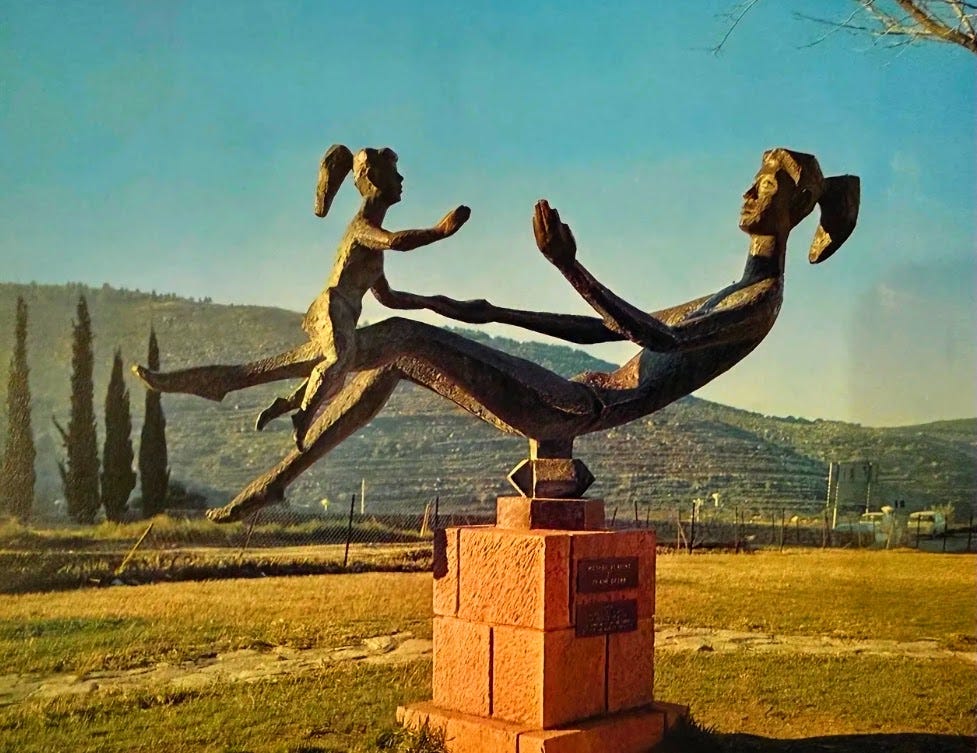
Today Laura Hodes has a deeply moving piece on the Radical Joy of sculptor Chaim Gross.
Then yesterday’s poetry folio, curated by Susan Comninos (with whom I trade weeks and co-edit the poetry section), is an absolute knockout.
As I posted yesterday on social media, poetry is my first love and formal poetry (adhering to structural rules for rhythm and/or rhyme, unlike free verse) is the sweet, sweet, sweetest spot at the very heart of the joy it brings me. So this folio devoted to exclusively Jewish formal poetry has to be my favorite of all time.
Here is just one poem by Boris Dralyuk, whom I’d never read before. After reading it, I immediately searched out much more of his work and fell wildly in love with it. I hope to showcase him soon!
*
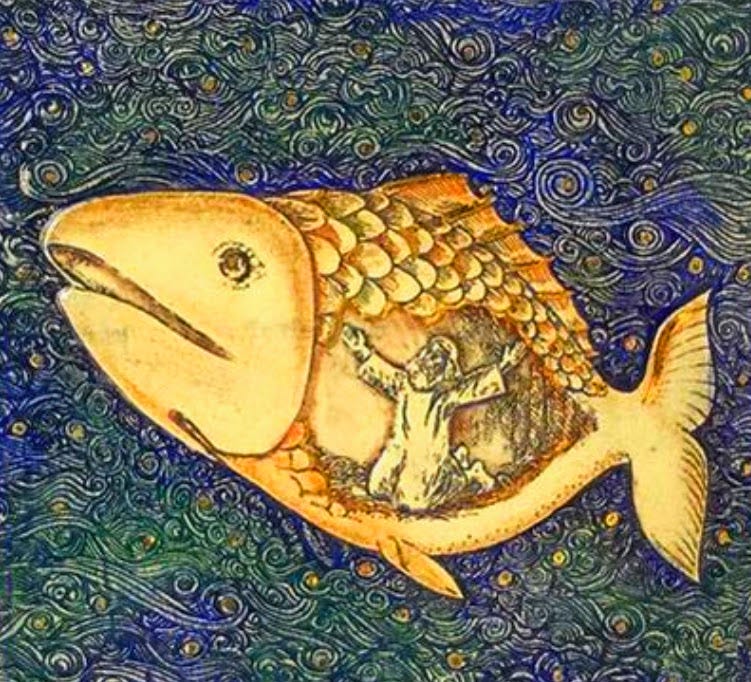
JONAH


Was this the end? He couldn’t rightly say.
There was no light. He lost all track of time.
If there was rumbling, it was too sublimely
steady to discern. Senses betrayed him.

Except, of course, there was the mealy smell
of his unlucky neighbors. Scales and slime
stuck to his fingers, too. He thought the climate
was hellish, even for a fish’s belly.

It’s true, at first he did give in to tears,
but these soon mingled with the brine and dried.
And in the end he grew to like the calm.

He hadn’t written anything in years,
but something in the rhythm of the tide …
He offered up a little psalm.

-- Boris Dralyuk
*
But what I most want to share with you today, with various links in case it calls to you too, is my recent fascination with and craving for niggunim.
Here I should say that music has always been the most potent way for me to connect with any Jewish service. I’ll go even further and say, as a non-believer, that without music there is almost never a way in for me.
So many therapeutic modalities are about bypassing the intellect, the thinking mind, and nothing else helps me do that. I can’t count the number of times in my life I have tried and failed to meditate. I’ve tried and failed to be hypnotized, regressed, afforded access to past lives. I believe in none of it and so it never works on me.
Moreover, in addition to my very strong resistance to everything under the woo-woo umbrella, I have a strong resistance to anything that isn’t Jewish. I’m not signing up for an Ashram, even one led by JewBus. I’m not going to India or Tibet for spiritual sustenance. I’m not turning to the Dalai Lama or Pema Chodron or Eckhart Tolle or Alan Watts or Glennon Doyle or Martha Beck or Elizabeth Gilbert.
So it was a very strange and anomalous experience to hook hard into a woo-ish gift sent to me by a stranger who’d been moved by a story I told very early in the recent Gaza War. She was a JewBu who’d made a long rigorous study of sound healing via Tibetan singing bowls and she sent me a recording she’d made.
No one was more surprised than me when it had a very potent effect on my bodily distress in those first few months of war. I’d listen to it as I was falling asleep and it worked like a charm to take me out of my racing mind and cantering heartbeat and into a place where I could sleep.
The recording was around half an hour long and entirely comprised of the intermittent tones created by her striking her singing bowls. Each individual sound would take a long time to recede. If you’ve ever seen a coin spiral, that was one image that came to mind when I visualized the sound. The coin is dropped and it spirals and spirals in smaller and smaller circles before it finally disappears.
Or another visual is a drop of rain falling into a lake, or a deep well, where it ripples outward at length before the water is finally still again.
This recording became my go-to for falling asleep at night. I would focus on the tones as they slowly dissolved and as I did that, I had the sensation, myself, of dissolving into the deep of sleep.
This made me curious about the ideas behind singing bowls as a healing modality and I read more about it. Obviously I’m not remotely the best person to talk on this topic, but here is the very general idea as I understand it:
The bowls don’t just create a sound you hear; like any sound, they produce vibrations you can feel.
Because our bodies are made mostly of water, and vibrations travel more efficiently through water than air, the sustained tones of the singing bowls can be felt internally (this might be why I visualized raindrops in a well).
These vibrations encourage bodily alignment with the sound, which pulls our attention out of our anxious thoughts and into visceral tranquility.
On the off-chance that you might want to experience this recording for yourself and see if it helps you in a similar way, I’ve pasted it in here:
In any event, again, for better or for worse, reasonable or not, I’m always looking for the Jewish version of any spiritual modality.
If I ever try yoga again, it will be Jewish yoga (yes, there is such a thing).
When I try fruitlessly from time to time to dabble in meditation, it’s Jewish meditation.
So I asked the internet if there’s a Jewish version of singing bowls and when it offered me the answer, it felt like a lightning strike of recognition.
Yes, Jews use sound in similar ways, and this takes many different forms.
The shofar is meant to shake our souls awake.
Torah isn’t read; it’s chanted. The trope system draws on breath, pauses, tension and release. The Kabbalah holds that the ta’amim (tropes) are not decorative or incidental but the spiritual animating force of the text.
In Jewish lore, creation is described as emerging through sound. The world is spoken into being. In Kabbalistic thought, Hebrew letters are not just symbols but energetic entities.
But maybe the most direct Jewish counterpart to the singing bowls, at least in my own experience, is our niggunim — our wordless melodies.
Over the last several months, seemingly just by chance, I have had many powerful experiences with niggunim.
Not long ago, I wrote about the experience of being on a very turbulent flight, in conditions where the pilot was uncertain whether it was safe to attempt a landing.
In those moments of terror (I don’t like flying even in the best of times), I had a very marked bodily response to the niggun crooned by my Hasidic seatmate. (You can revisit that story here.) Focusing on that niggun brought about the seemingly impossible: I felt myself relaxing in the midst of this terribly frightening event.
I also attended an evening event at our local Chabad about the various niggunim that were the spiritual trademarks of each rebbe in their dynasty, where there was a live performance of these by a string quartet along with a film titled This World Is A Garden.
And then, late last month, I went to a class about niggunim here in Portland led by a woman who’d been raised secular and very superficially observant, who then found her way back to Judaism through niggunim.
She told me she’d tried countless other spiritual traditions, searching for one that would resonate with her. She was a Wiccan. She was a Pagan. She dipped into all kinds of New Age practices but never felt fully invested in or satisfied by any of them. And then one day, she wandered into a local shul for some incidental reason, where a niggun was in progress, and she found herself sobbing uncontrollably.
She remembers saying to herself: This is how prayer is supposed to feel.
And all I can say is that, once I began consciously exploring niggunim, I feel as if I too can’t get enough. They steady me and transport me and connect me to our people and make me happy. And I wanted to offer them to you as we go into the Sabbath in case they speak directly to you in the same way.
One of our greatest niggunim artists of today is the incandescent Joey Weisenberg.
For just a fleeting taste of his music, here is just one of a treasure trove of clips:
I’m even considering signing up for a retreat let by Joey next month in the Boston area, so if you live in Boston and would let me crash on your sofa, drop me a note.
In any event, I hope his niggunim bring you at least some measure of the peace and inspiration they bring me.
Okay, fam. I’m wishing you a nourishing visit with the Sabbath Queen.
I’ll be back with you on Monday with the usual worldly turmoil, I’m sure.
But in the meantime, I’m sending you love and sustenance and wordless spiritual melodies.
Shabbat Shalom.
Am Yisrael Chai.
Shabbat Shalom. You might like Shefa Gold, she has a big chanting community - ha, a big community who chant, who learn to chant, who go to retreats with her to chant. The bursting into tears thing is a thing, for sure. It happened to me as I sat in the back of a morning prayer service at a Jewish Institute for Spirituality retreat. I was in the back because prayer wasn't interesting to me. Then, the music slayed me. And then, to top it off, I had to send one of the staff out for sanitary products, which was a shock because I thought menopause was waaaay in the rear view mirror. Tears and blood, with a little bit of sweat to make it complete.
I may have a place where you can stay in Boston. Let me know the best way to reach out. (Messenger? Reply to the Substack newsletter?)