
Escape Artists
Children Of Israel Are Never Alone


Hey, beloved tribe.
It’s Friday, my day to bring you uplifting offerings from all over the Jewish world, so I’ll start with the poetry of Henry Israeli, which ran yesterday over at JUDITH.
One evening last year, I found myself with half an hour to kill before meeting my husband, so I wandered into a near bookstore and picked up The Best American Poetry 2025. It was there that I discovered Henry Israeli — specifically his poem Escape Artists (included below). It had been a difficult day and I was feeling low, and the memory of how this poem exhilarated me remains as vivid as the moment it happened. I remember having a sense that my evening had been redeemed, that I needed nothing else from the day’s remaining hours, and I left the store with a very different feeling than the one I’d walked in with. His other work is just as potent, and I couldn’t be more delighted to share some of it with you.
Here is the poem I read that night:
ESCAPE ARTISTS

Who remembers Tony Curtis as Harry Houdini immersing himself
upside-down into a tank of water in a strait jacket with a bundle of chains
wrapped around his chest only to emerge mere minutes
later to take a bow? The trick was there was no trick,
just skill and a hidden key—in his mouth, I think, although
my memory of it is hazy.
                                                My father had to cover himself in leaves
and snow to blend into the forest ground which was his bed
for over a year. His uncle once lay dead
still beneath a plank under a bale of hay in his Polish girlfriend’s barn,
and when the bayonet pierced his shoulder through straw and board,
kept completely silent.
                                            What Jew hasn’t, at one time or another,
had to become an escape artist? Harry Houdini, born Eric Weiss,
son of Rabbi Mayer Weisz, years earlier dropped the “z” to sound
less Jewish upon coming to America from Budapest.
Bernard Schwartz vanished behind Tony Curtis,
and starred in over a hundred films, including Houdini in 1953,
which ends with Harry pulled from a water tank,
dying from a ruptured appendix,
promising his wife “if there’s any way, I’ll come back”
because even he couldn’t disappear forever.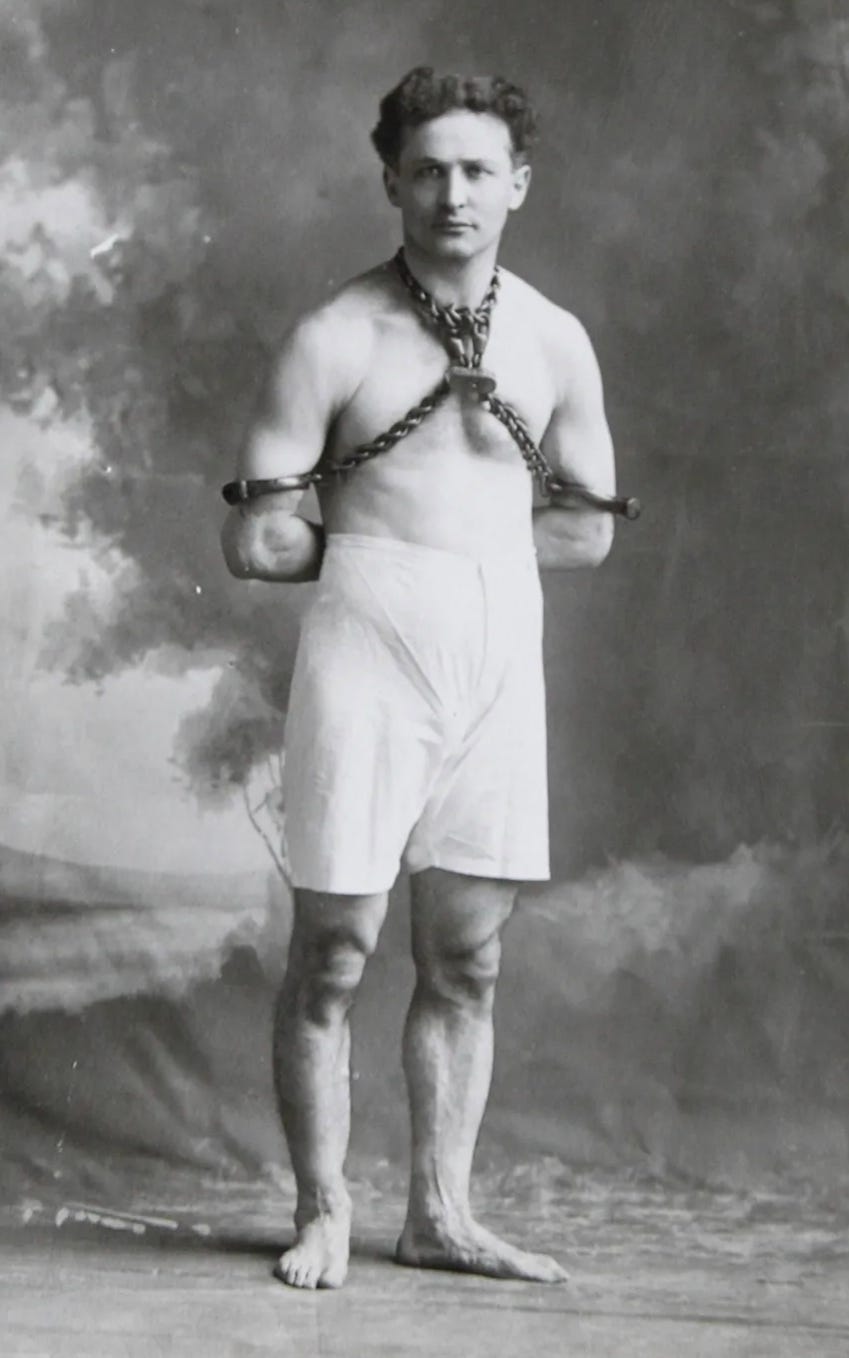
You can read the rest of Henry’s showcase HERE.
✡️
One of the filmmakers I met at the Upstart conference was Isaac Kates Rose of ALBI | Fund. Institute. Lab. His film is Holding Liat, which follows the family of hostage Liat Beinin Atzili through the excruciating months of her time in captivity.
It’s an extraordinarily intimate film. We witness scenes that most subjects would not have consented to release for public consumption: sharp arguments between family members, raw grief, rage on countless levels.
The family member we follow most closely is Yehuda Beinin, Liat’s father. His way of staying sane was to relentlessly campaign in the west for his daughter’s release. The film is candid about his frustration with countless players — he hates Netanyahu, very understandably, for seeming totally uninvested in the hostages’ return.
But there are also moments of rising frustration with a right-wing Jewish rally, replete with reductive and offensive rhetoric; with representatives of Chabad, who believe the only thing Yehuda needs to be doing is praying to Hashem for a miracle; with his anti-Zionist brother, who lives in Portland and who can’t shelve his politics for a moment even in his own family’s hour of direst need.
One of the most striking moments in the film was Yehuda’s encounter with a Palestinian advocate in the halls of the U.S. capitol.
Because Yehuda has to keep the tenor of his public discourse within a narrow set of politically safe parameters, he can’t speak freely with the Palestinian, with whom he clearly agrees on much. Both men hate Netanyahu and feel that both Israelis and Palestinians are the victims of extremist leaders.
At one point, the two men are leaning into each other, whispering their true feelings and thoughts so as not to be overheard by anyone who could take issue with the sentiments they were expressing. It was one of the most poignant moments in the film.
Very unfortunately, the anti-Zionist uncle was at the theater last night, on a panel of three that included a local rabbi and one of the filmmakers in addition to himself.
He was there because he was a family member and he’s local, a Portland resident.
I actually left in the middle of the Q&A because I could not listen to him. As I was walking out, he was arguing with an elderly audience member who’d taken issue with one of his statements — as the panel had explicitly invited participants to do.
The uncle had said the IDF totally destroyed all of Palestinian society. This elderly woman urged him to be more precise and accurate when he spoke, since he’s a professor and a person of authority. She pointed out that the IDF had destroyed a lot of Gazan infrastructure and knocked down a lot of buildings, but it had not destroyed Palestinian society, which I thought was absolutely right.
But as he began forcefully arguing with her, I stood and left the auditorium.
Outside the women’s room, I ran into a woman who knew me from social media and we got into an odd conversation. Apparently I’d unfriended her, but since I had no memory of doing so or why, I was very friendly when she came up to me, leaving her confused. As we were talking, there was a commotion in the hall. The elderly woman was now outside the auditorium as well, and a young man was in her face, screaming at her to leave the theater.
At which point I broke off in the middle of my sentence and ran over with my pepper spray, telling him to back the fuck off her.
I said, “What are you doing? Audience members were explicitly invited to take issue with any aspects of the film that troubled them. She was perfectly within her rights to say what she said.”
He said: “I don’t care what she says, but she needs to say it out there,” and he pointed to the sidewalk on the other side of the glass doors.
I said: “This is a public space! You have no right to tell her to leave, who the hell do you think you are?”
At this point, several theater staff came and ushered him away and I continued talking to the elderly woman, who was shaken and upset. I told her I thought she was absolutely right — that the uncle was trying to justify the libel of genocide and she was right to push back against that.
My feelings about the uncle, however, did not ruin my experience of the film at all. I found it utterly riveting, compassionate, nuanced, candid, poignant and filled with bittersweet beauty.
✡️
Finally, I want to provide an intro to the work of the woman I mentioned in the last newsletter: Shlomit Bard Levy, whose photography project is the best imaginable answer to the inane characterization of Zionism as a white European colonial project.
Her portraits of Israeli Zionists from all walks off life are smashingly beautiful. Here is just one, of Fanta Prada, an attorney and owner of Balinjera, a restaurant in Tel Aviv:
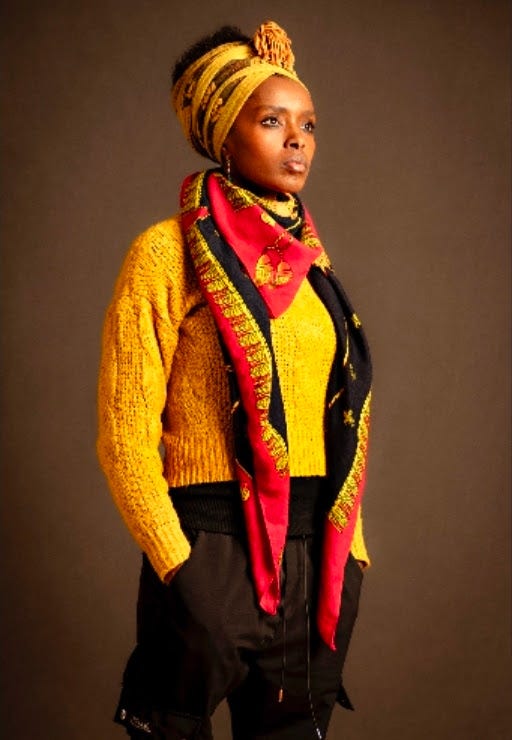
The text around her photo says:
Ever since I was a child in Ethiopia, all I heard was my parents’ dream to come here. My mom would talk about Jerusalem almost like you speak about a lover you long for; she would pray for it every day.
Our journey was so long and hard. We went from village to village. We had no childhood. We had no place of our own until we could leave Ethiopia.
When we arrived, my mother said, “I’m home. We finally came back home.”
For more gorgeous portraits, you can visit Shlomit’s site (Re)Defining Zionism HERE.
✡️
Okay, fam. I need to go braid my challah loaves now! I’ll be back with you next week. I hope your Sabbath feels restful, restorative and meaningful.
As always, all my love in the meantime.
Shabbat shalom.
Am Yisrael Chai.
Now I know precisely who I want by my side with her pepper spray and foul mouth if I am ever in a jam. I may be a butch lesbian, but I have nothing on Elissa--our fierce and intrepid hero.
You are so fabulous