
The First Ghetto
Children Of Israel Are Never Alone

Hey, beloved tribe.
I’ve returned from Italy and though it was a magnificent trip, I’m so glad to be back with you — and this will be my final report from the Italian front.
Our final destination was my favorite by far, for so many reasons.
Venice is the most beautiful city I’ve ever seen, and completely unlike anywhere I’ve been before. And the beautifully preserved Jewish ghetto there — the oldest in Europe, and the place where the word “ghetto” originated — offered far more Jewish history and culture than anywhere else we went.
On one level, the conditions for Jewish life during the three centuries that Jews were confined there sound very far from ideal. The quarters were cramped and crowded, and as the population swelled, wooden partitions were added to further divide the scant available housing. Ceilings were lowered as well, in order to construct additional floors — leading to such shrunken quarters that in some apartments, it was nearly impossible to stand upright. Some buildings ultimately climbed as high as nine stories (and later had to be lowered due to their extreme instability). Its guarded gates were locked at sunset, which essentially imprisoned the Jewish residents there until dawn.
Just past the ghetto entrance is a plaque from 1704, on which is inscribed a “decree from the Blasphemy Commissioners of the Venetian Republic”, which includes a dire warning to would-be dissembling conversos:
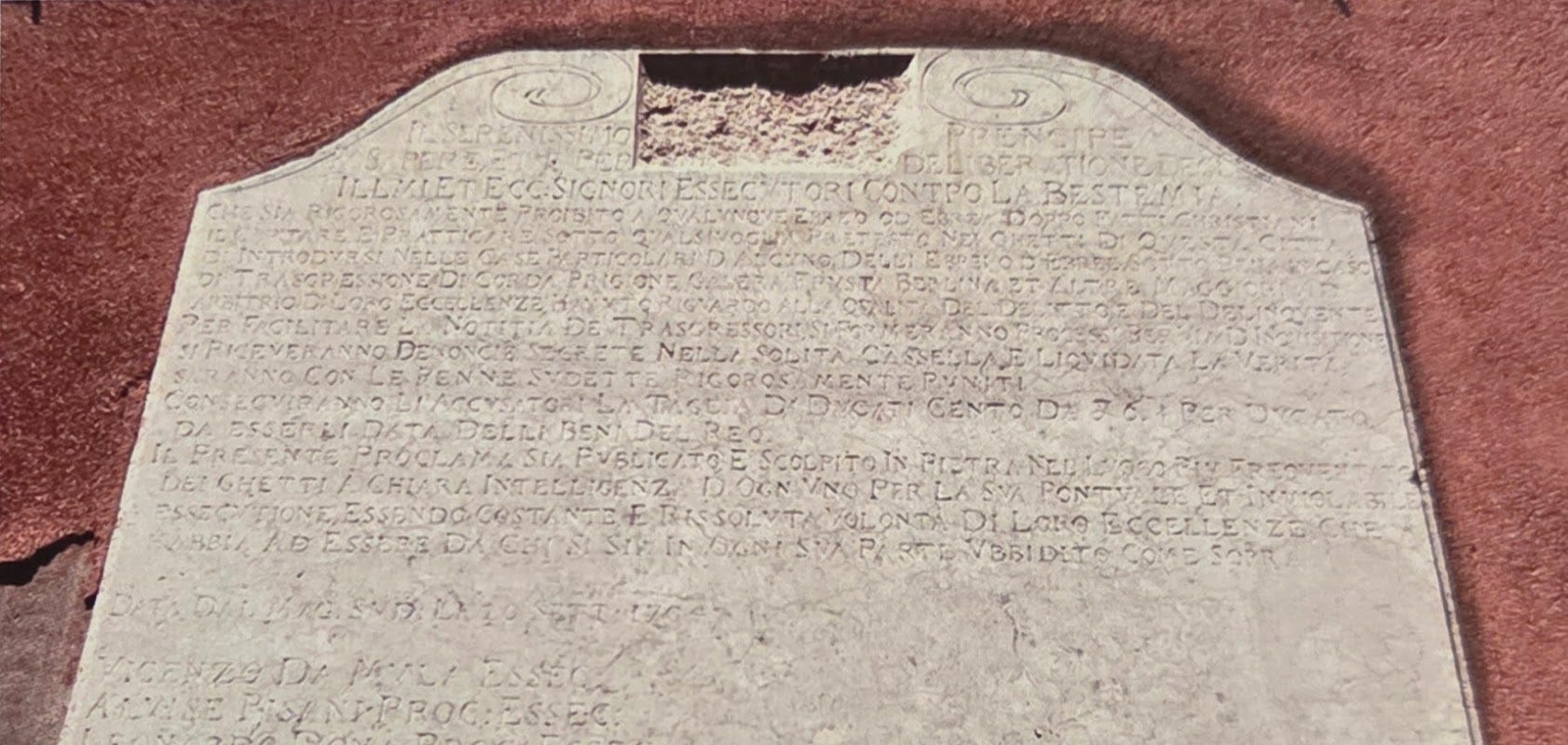
…it is strictly forbidden for any Jew or Jewess, after converting to Christianity, to enter or practice under any pretext in the ghettos of this city or to enter the private homes of any Jews or Jewesses. Violation of this decree will result in penalties including the rope, imprisonment, galleys, whipping, pillory, and other severe punishments at the discretion of their Excellencies.
And yet, Venice was a haven for Jews compared to the surrounding territories.
To the north were the Alps, where the Jews were either at the mercy of often-violent local lords and traveling monks, or under the domain of the Holy Roman Empire, whose rule over Jews was marked by expulsions, the enforcement of distinctive badges or hats, exorbitant taxation, exclusion from guilds and property ownership, and the confiscation and destruction of Jewish religious texts.
To the south and west were the Papal States, where conditions were worse for the Jews due to the oppressive policies of the Roman Inquisition and the Catholic Counter-Reformation. In 1553, Pope Julius III ordered the burning of the Talmud and all related Jewish texts in Rome and other Italian cities. The Roman ghetto was much worse than the one in Venice due to chronic flooding, disease and intense pressure on Jews to convert.
To the east was the Venetian hinterland, where Jews lacked even the limited protection of the Venetian government and were continually vulnerable to forced expulsions, pogroms, and financial catastrophe.
So as segregated, isolated, and inferior as the conditions were in the Venetian ghetto, they were better than any of the adjacent alternatives. While the Jews there were shunned and disdained by much of Venetian society, they were also recognized as essential to the state since they were forced to play the much-needed role of money-lenders. And so they were allowed to remain ensconced there as legal residents, and most importantly, they were allowed to be Jewish.
So you can guess what happened, can’t you?
Under this modest set of permissions, the Jewish community within the ghetto of Venice positively thrived, converting their modest and confined quarters into a vital cosmopolitan center. They built five glorious synagogues and a slew of yeshivas and Jewish academies. They produced merchants with extensive international trade networks who were crucial to the Venetian Republic. They produced physicians who were renowned for their competence and skill — and who were often sought out by Christian patients across the city. They established printing presses and eventually became a worldwide hub for Jewish literature and publishing, creating exquisite editions of the Babylonian Talmud and Hebrew bible. And they fostered many rabbis, intellectuals, and poets.
I learned all this on the tour I took — the only Jewish tour that my kids readily joined and subsequently loved — and the guidebook I bought. And I spent most of my day there, visiting the two synagogues that permit public access, other Jewish landmarks within the ghetto walls, and a range of beautiful Jewish art galleries and Judaica shops.
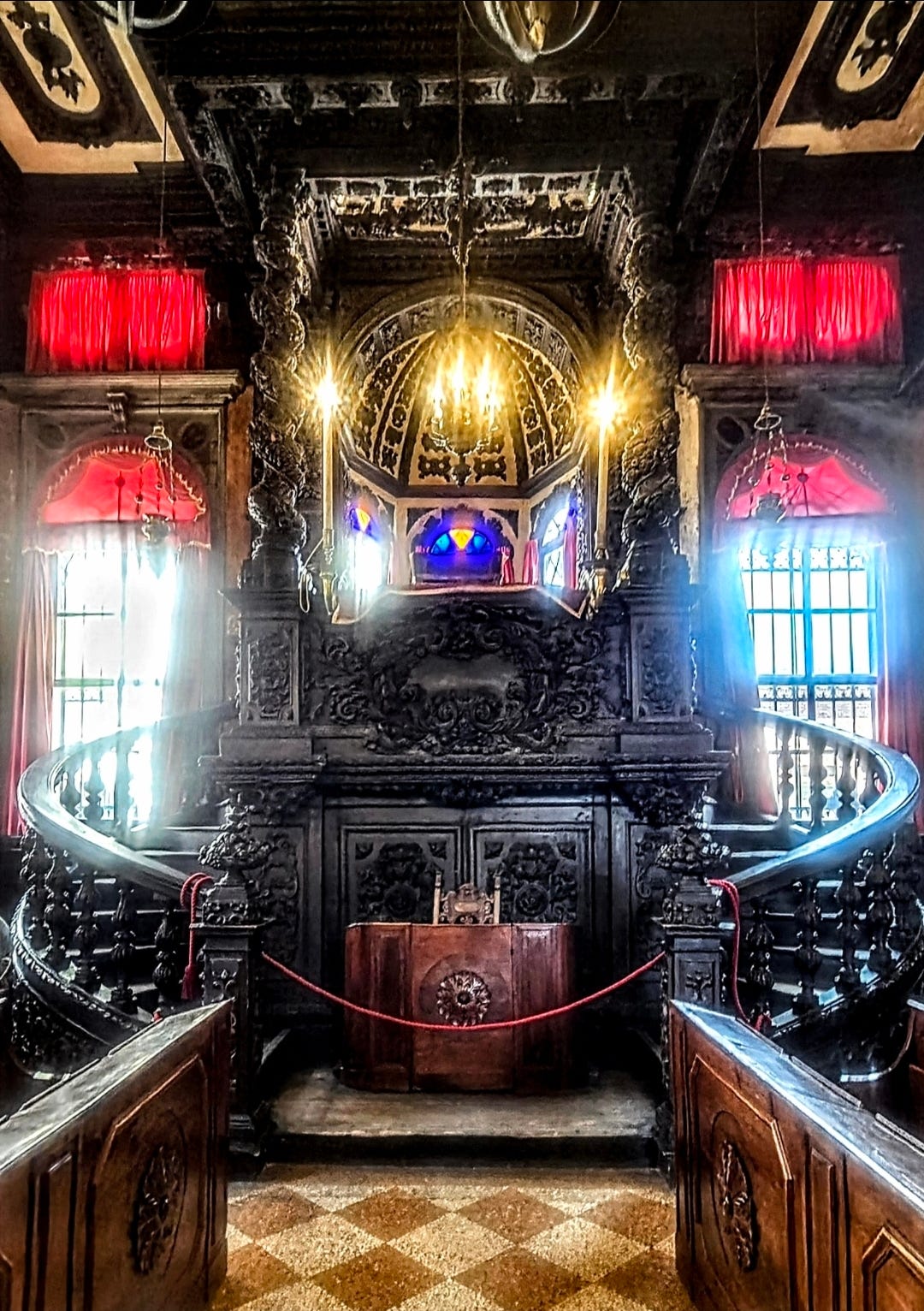
The Levantine Synagogue was my first stop, and I apologize that my photo is less than ideal due to the very bright light streaming in the windows while I was there:
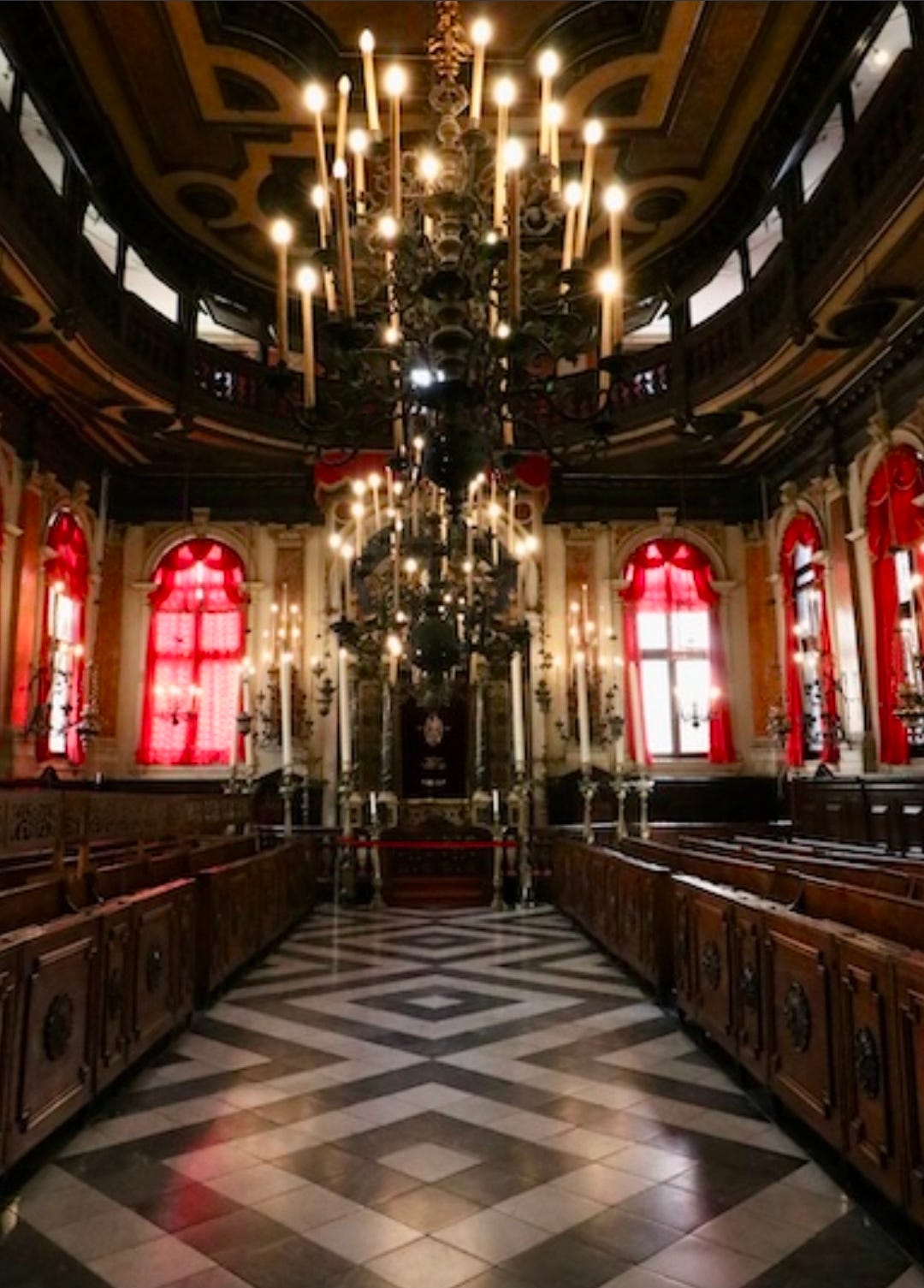
My next stop was the Spanish synagogue, which was similar in design but twice the size:
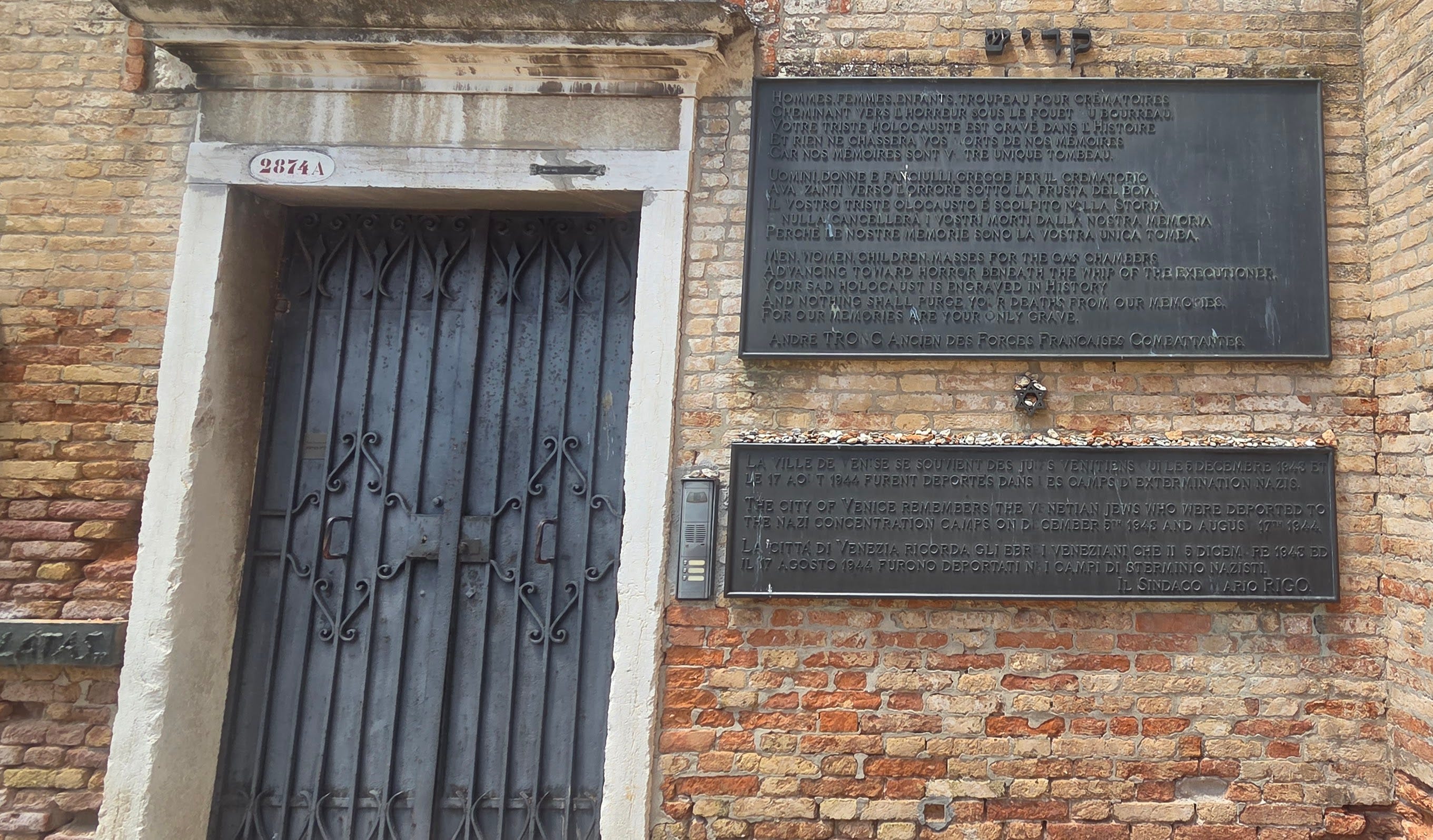
I also visited a haunting outdoor memorial in honor of the victims of the Shoah, with a series of harrowing bronze bas-reliefs created by Lithuanian (and Jewish) sculptor Arbit Blatas:
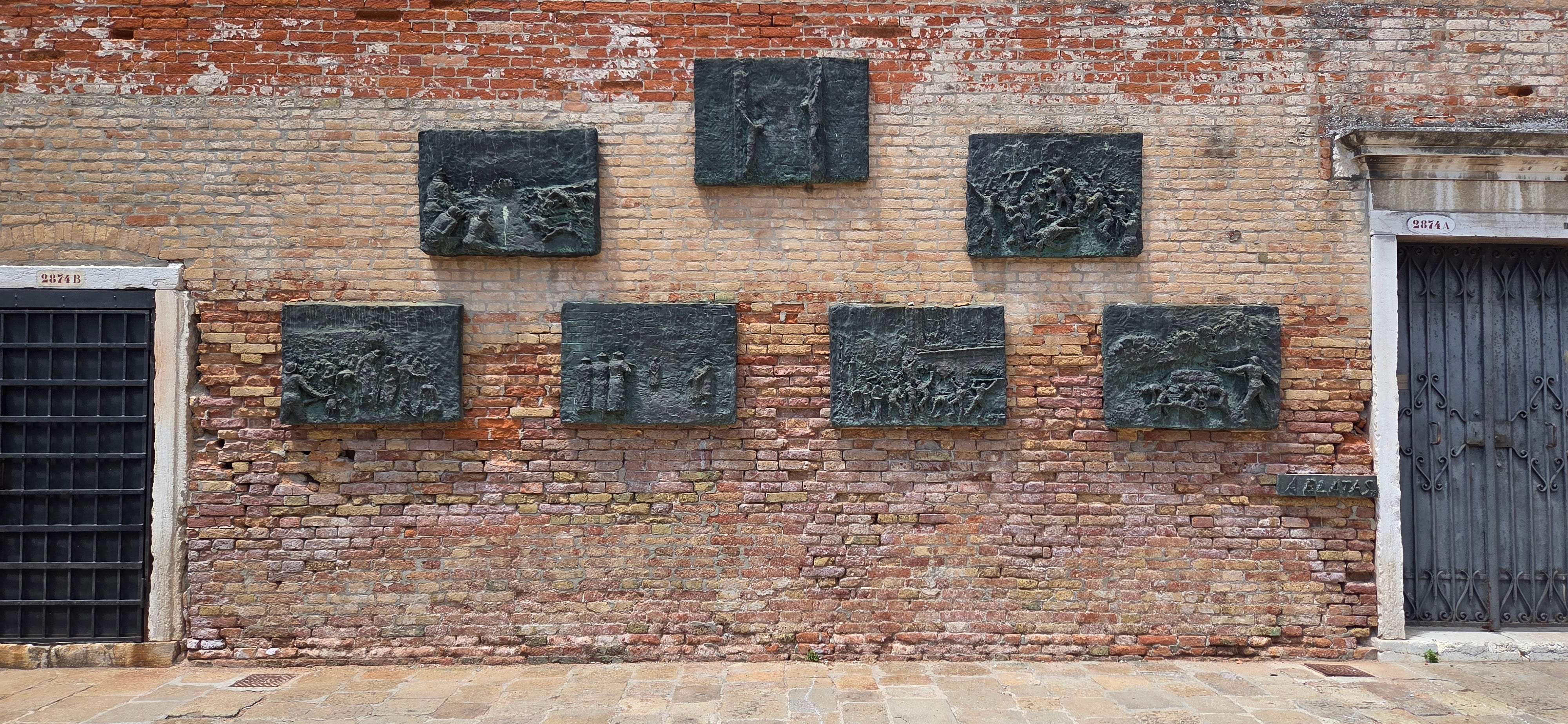
Nothing shall purge your deaths from our memories, for our memories are your only grave, reads part of the poignant inscription on an adjacent plaque.
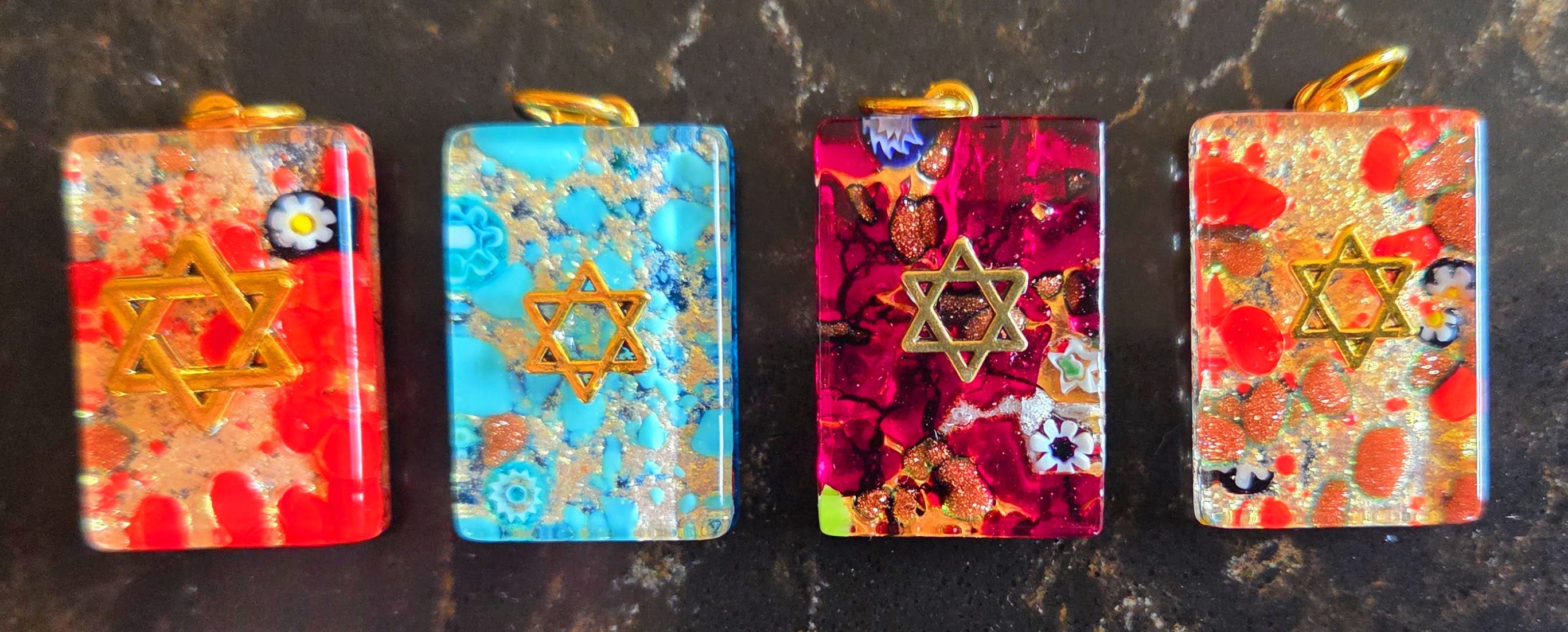
At a tiny nook called David’s shop, I bought several beautiful Jewish pendants made of Murano glass.
There was an open kosher bakery called Volpe’s, which my guidebook described as selling “exquisite pastries based on ancient recipes handed down by generations of Ghetto grandmothers.”
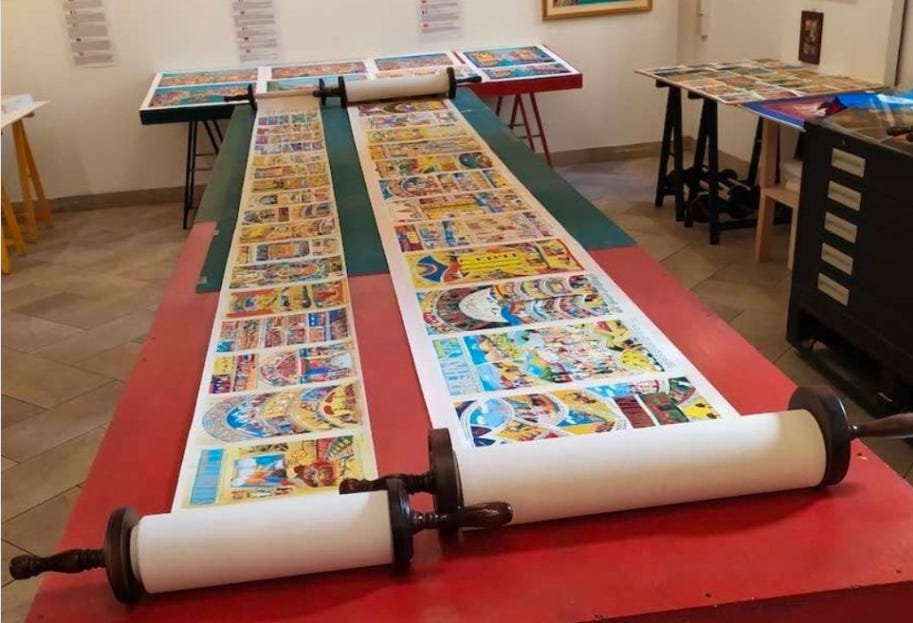
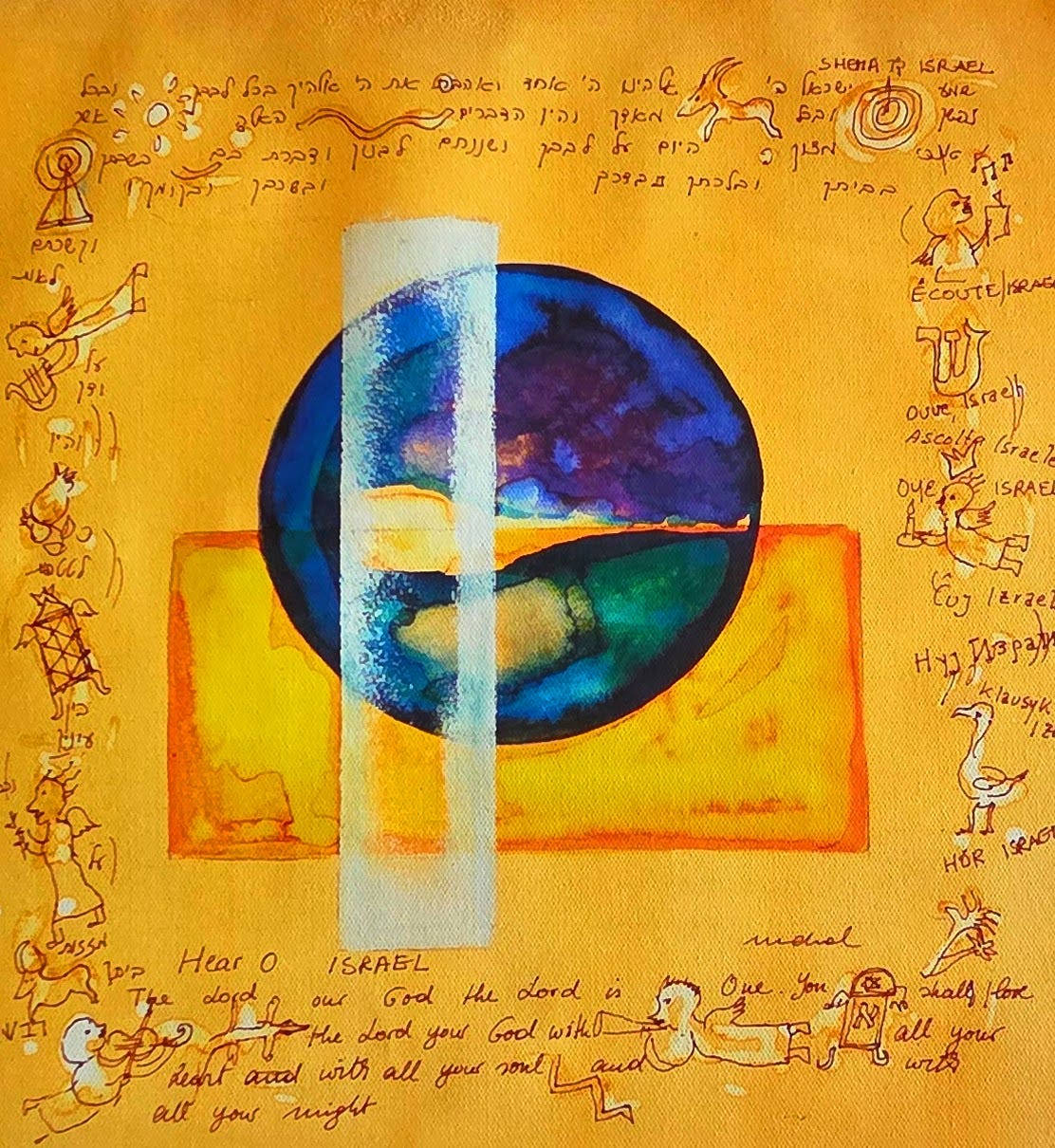
Across from that was a studio and gallery called ScalaMata, where artist Michal Meron spent almost five years working on his Illustrated Torah Project: rendering the five books of the Torah in vivid illustrations on a scroll.
It was here that I bought what I consider a stunning print with a Kabbalistic illustration of the Shema.
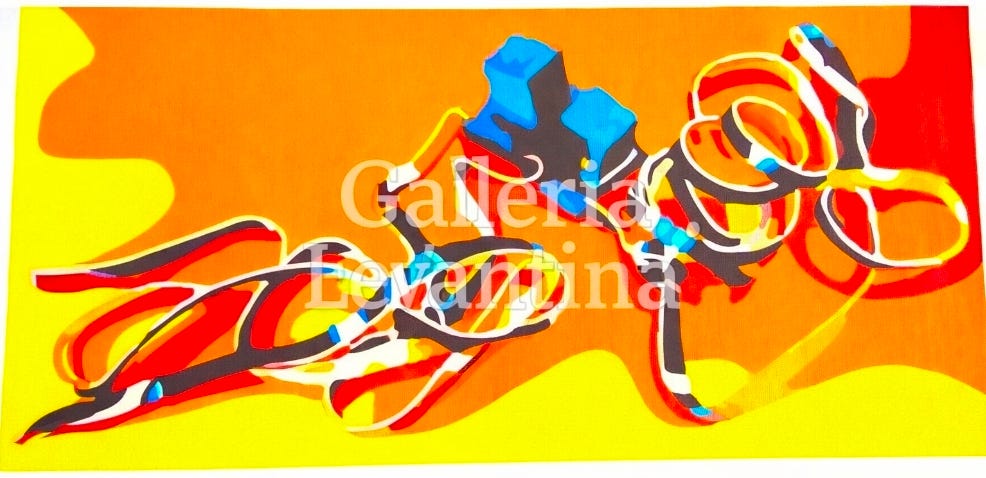
But my very favorite acquired print came from a smaller showroom called Galleria Levantina. The woman working there seemed very worried about photos of their artwork being commercially abused by way of illicit replication, so in order to respect her concern, I’ve superimposed a watermark. Hopefully the beauty of the rendering of tefillin comes through despite that protective measure.
Fam, I can honestly say that with every facet of Jewish history, heritage and culture I experience, the more impressed I am by our people’s tenacity, brilliance and resilience; the more moved I am by how consistently we rise wherever we are and whatever we’re subjected to; and the prouder I am to be Jewish — the more in love I am with who we are and have always been.
I hope I’ve succeeded, with these accounts, in imparting some of that love and pride to you.
I’ll be back with you very soon, and will be returning to life here and now.
I send you love and light in the meantime.
Am Yisrael Chai.
Beautiful & evocative. Thank you for helping us see our heritage, ourselves through your loving eyes and heart.
We visited the Jewish Ghetto in Rome and the Great Synagogue of Rome. It was tear inducing to think of what happened, and inspiring to hear stories of support and survival. Jews were allowed 2 jobs. Money lending and later selling of used clothing. Yet today, they are criticized for being savvy “bankers.” The irony and antisemitism are not lost on me. There are plaques placed in front of each home known as Stolpersteine (German for "stumbling stones") showing the name, birth and death of each person killed by Nazis. Heart wrenching.