
Two Sabbath Queens
Children Of Israel Are Never Alone

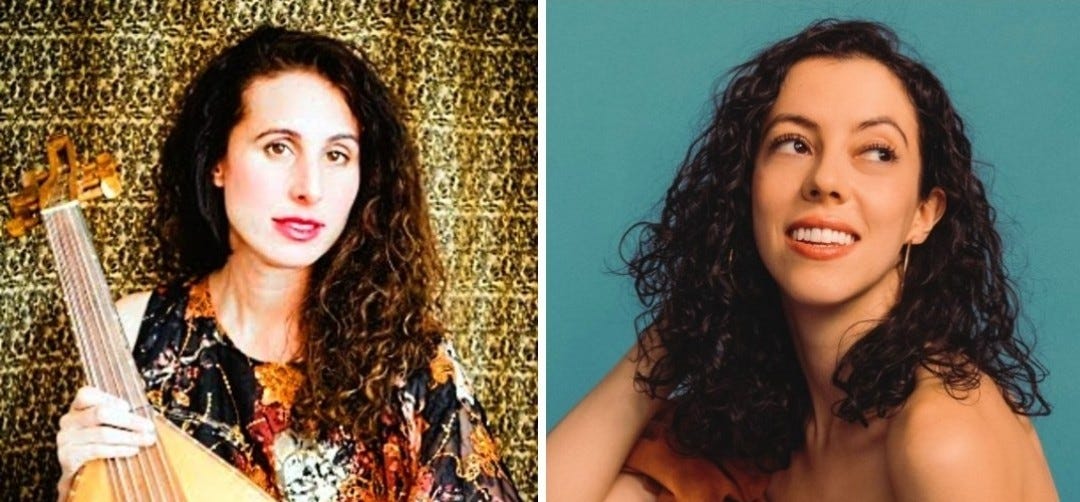
Hey, beloved tribe.
As I think I’ve mentioned, I realized I couldn’t do a full-blown Jews Of The Universe [JOTU] column every single Friday. So I’ve reverted to every other Friday.
But I still want to tell you about two impossibly beautiful Jewish artists who are so near and dear to my heart. I want to create a full JOTU column for each of them soon, and one of them as soon as next Friday.
But I have to confess: whenever I profile my longtime friends, as opposed to those who are yet to become friends, I experience this very wistful desire to not only record their own words but to tell you about them from my own perspective. And because I’m hoping to direct interest and support to things each of these two are doing in the very near-term, I’m going to indulge in that desire here. Trust me when I say that an intro to the music of both will immeasurably enhance your Shabbat.
I vividly remember the first time I really connected with Basya Schechter (on the left, above). We were seniors in college and had a class together, though not one so small or intimate that I’d gotten any real sense of her. So when I ran into her in a bookstore near campus, I expected nothing more than a superficial exchange of pleasantries when I said, “Oh hey, how’s it going?”
“Terrible,” she said matter-of-factly.
I was startled by this answer. I peered at her more closely. She didn’t seem to be joking, nor did she particularly seem to be in distress. She had said terrible the way other people say fine.
“I’m sorry, what?”
“Terrible. Awful. I’m having a really bad semester, to tell you the truth.”
How can I explain how charmed I was by this – by that knee-jerk authenticity, without any regard for social convention?
Of course I invited her to tell me more. We went for coffee and we talked for a long time and then we never really stopped talking. And over the weeks and months and years ahead, my fascination with her just deepened.
She was the first person I’d ever met who’d been raised Orthodox and broken out of her ultra-religious sect, though she exuded Jewishness in everything she said and did.
She was not an orphan but there was an orphan quality about her. Not only was she out of her family’s close-knit fold in the ways that mattered most to them, but she had 17 siblings (kayn ahora!) and her parents were terminally preoccupied. They also had no money. So in the deepest, most essential ways, she was on her own in the world, with no safety net, no model for the life she was living, no counsel that was relevant to her, and no truly present parental figure as a source of attention, concern or support. She was always broke, always stressed out, and more than any other friend I’d had at that time, she was fending for herself in the world.
She was so intensely alive and always ready to laugh, at every kind of absurdity and especially at herself, but she also wept daily, even several times a day, more than anyone I’d ever known. She told me it was genetic, that her mother and her mother’s mother had been the same. She would have done anything to dam those tear ducts, to stop the flow, but she couldn’t; the moment she felt a pang of sadness about anything, she began leaking at the eyes. To this day whenever I hear the song that opens: This is the story of a girl / who cried a river and drowned the whole world, I think of Basya.
She was the freest spirit I’d ever encountered; there was even a genuinely wild quality about her. I remember a Fourth of July holiday when we were both in Montauk at the same time, though we hadn’t gone there together. She liked to take off during long weekends and spend time alone in nature. There was an abandoned fort near the ocean and she would sleep in it by herself, on the ground.
For my own part, I was there with my boyfriend, who had a little surfer shack on the water. We invited her for dinner, and she came, and then she announced she was heading out to sleep in the fort.
We were scandalized by this. “Don’t sleep in the fort!” we said. “Go commune with the moon or whatever it is you came out here to do, but then come back and sleep on the sofa.”
“Okay, maybe. Thanks,” she said, and then we didn’t see her again until she wandered back late the next morning, covered in ticks. I remember her standing on our porch and weeping as we pulled about half a dozen of them off her. I remember feeling the same mix of emotions I always felt around her. I felt consternation. I felt dismayed, disbelieving. I felt mystified by her and sorry for her and and I remained as fascinated by her as ever. I was in awe of her vagabond prowess, her absolute freedom. She was like a feral cat: appreciative of creature comforts where she could get them, but never to the point of being tamed.
She had two all-consuming passions – music and world travel, and these two were soon woven together. Her wanderlust was insatiable and everywhere she went informed her musical sensibilities. She went to Israel after high school, where she hitchhiked all over the country and went every night to secular concerts and bars, which got her kicked out of the ultra-Orthodox yeshiva where she was supposed to be studying. Immediately after this happened, she decided on a whim to go to Egypt with friends, and there she was rocked to the core by Middle Eastern music, besotted with it.
Back in the U.S., she went to Barnard for college and there she began playing the guitar and writing songs with an obsessive fervor. She spent her junior year abroad, going to South Africa, Zimbabwe, Zambia, Malawi. During another stint in Israel, she took a boat to Cyprus, and then Turkey. Later she went to Greece, Rhodes, Morocco, all over Eastern Europe, and so many, many other places. And everywhere she went, she absorbed the traditional and cultural music of that place, and her musical compositions took on more and more world influences.
In our twenties, I remember so often feeling that old mix of exasperation and awe whenever I considered her travel habit. She was always on the edge of true privation, always panicked, frantic, about how she was going to make ends meet, but the moment she got any kind of monetary windfall, she’d blow it on another plane ticket and disappear into the next far-flung corner of the planet.
It was only later that I came to feel that this heedless, hellbent insistence — on roaming every corner and crevice of the world, at any cost — was among the very most extraordinary and beautiful of her many extraordinary and beautiful character traits. I came to feel that her absolute refusal to trade any level of security or stability for what her soul craved most represented the fiercest kind of artistic purity — and I came to realize, too, that very few of us have the strength or the fortitude to be that true to our most essential selves.
Today Basya is a much-beloved and celebrated voice in the Jewish music scene, with a working knowledge of dozens of instruments from all over the world. She’s known for her innovative and brilliant reinventions of ancient melodies and prayers.
To provide just the briefest, slightest intro to her music, here is one clip:
Right now, she’s working on a new album called Songs of Desire, which she describes as a “sonic midrash,” a commentary written not in words but in sound, layering ancient melodies with new interpretations from [her band] Pharaoh’s Daughter: a band whose music blends the old and the new -- sacred text on oud, whispers of Hebrew refracted through electric strings. Think klezmer meets trance, Middle Eastern maqam, West African pulses, mingling with a Brooklyn beat.
To read more about it, and to join me in supporting this project, please visit this link.
✡️
Onto Lily Henley. If you’ve been with me from the very start of this newsletter, which is nearly a year old, you might remember a story I told within the first month of launching. To recap: very soon after October 7th, a friend I identified as “L” was visiting Portland (where I live) from NYC (where she lives) and we were having coffee and talking about the massacre and burgeoning war.
At the very next table, by freakish chance, was a Palestinian man who broke into our conversation. He was soon joined by his mother and sister, and the latter and I very nearly came to blows in the ensuing heated conversation.
And then things took a turn. I don’t want to ruin the story for anyone yet to read it. And if you didn’t read it then and you’d like to read it now, you can do so here (just skip the brief opening about Nas Daily — it’s right after that).
But suffice to say, a lot of people had a very emotional response to that story and a LOT of people begged to know: who was the brilliant and mysterious L who was so pivotal to the way things ultimately turned out?
So as I revealed soon afterward, “L” stands for the luminous, lovely, lyrical, lion-hearted, Ladino-crooning lady Lily Henley.
And if you were among the NYC locals who hoped your path might cross with hers in some way, someday, then this is your lucky month. She is playing on January 30th at Joe’s Pub at 7 pm. If you can, I implore you to go.

The first time I ever heard Lily play, we were only Facebook friends. She came through town and invited me to a local show she was doing, and I told her I would be there. I remember when the day came, I desperately did not want to leave the house. This had absolutely nothing to do with Lily; I was just so tired, the weather was awful, and all I wanted was to hole up at home with a mug of soup.
But I said I’d be there, so I went.
Fam, the concert was so exquisite and moving and beautiful that tears came into my eyes during the very first song and I wept steadily throughout the entire show. True story. I was so inexpressibly grateful I’d gone. And that marked the beginning of our friendship.
For the briefest intro to what Lily does, here is another clip described as a casual solo performance of Sephardi songwriting legend Flory Jagoda’s “Pesah A La Mano.”
So please go to her show. And give her my love.
Shabbat shalom.
Am Yisrael Chai.
I once heard Basya Schechter sing in concert. I never forgot it. It was truly mind blowing extraordinary. And I’m going to say something weird here. I don’t believe in the orthodox Jewish prohibition of hearing a woman’s voice (well I’m a woman but I mean for a man) although I’m a traditional Jew. But when I heard Basya I (kind of) understood it (still didn’t agree). Her voice was so sensual so unique it could make you fall in love with her.
I've been following her for some time and she is truly lovely in all ways. And of course I'm not surprised to find out how complex she is. Her voice and music is a treasure.